

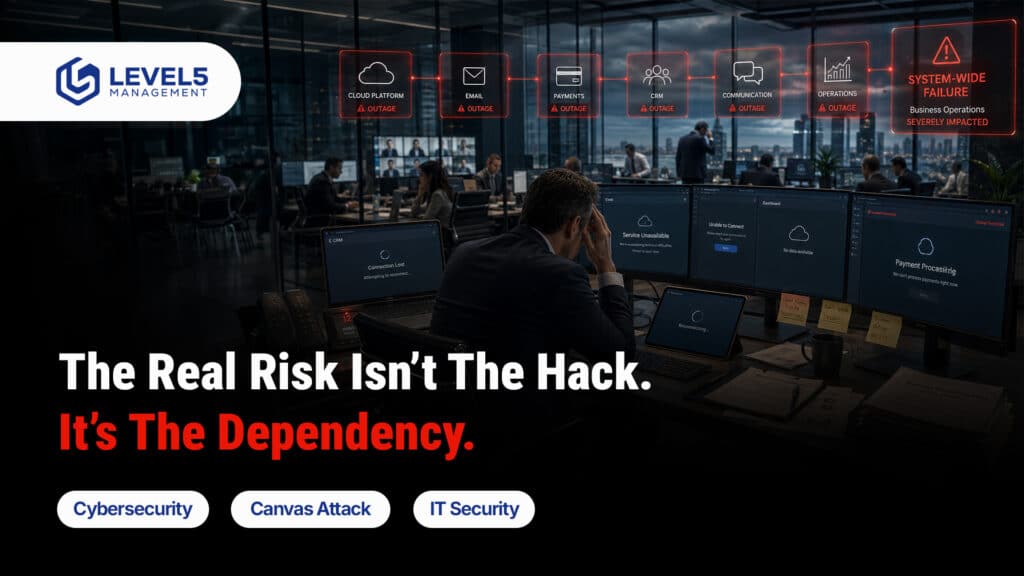
Hackers hit one of the most relied-on platforms in American education right in the middle of finals week. The real lesson isn’t about students. It’s about what happens when one vendor your business depends on gets breached. Here’s what actually happened, in plain English, and 7 steps every owner should take this week.
What Happened In Plain English
We’re not a news outlet, so we’ll keep the reporting tight and stick to what’s been publicly confirmed.
According to reporting from CNN on May 7–8, 2026, students and staff at universities and school districts across the United States logged into Canvas, the cloud learning platform operated by Instructure, during finals week and saw a ransom note instead of their coursework. Canvas has more than 30 million active users and more than 8,000 institutional customers worldwide, per Instructure’s own website (cited by CNN).
A criminal extortion group known as ShinyHunters publicly claimed responsibility. The message, seen by CNN on a University of Washington student’s screen, read in part: “ShinyHunters has breached Instructure (again). Instead of contacting us to resolve it they ignored us and did some ‘security patches.'” The group set a public deadline of the end of the day, May 12, 2026, for Instructure to respond.
Instructure confirmed on its public status page (per CNN) that it placed Canvas into “maintenance mode” while investigating, and later restored service “for most users.” The company also disclosed that a separate incident on May 1, 2026, had exposed user names, email addresses, and student ID numbers.
Universities publicly named in CNN’s reporting include Columbia, Rutgers, Princeton, Kent State, Harvard, Georgetown, the University of Pennsylvania, the University of California, Riverside, MIT, and James Madison University. School districts in California, Florida, Georgia, Oklahoma, Oregon, Nevada, North Carolina, Tennessee, Utah, Virginia, and Wisconsin were also affected. James Madison University rescheduled exams as a result.
(Source: CNN, “Canvas hack strands university students during finals week,” updated May 8, 2026. Where specific technical details have not been publicly confirmed, we are not speculating.)
That’s the news. Here’s the part that actually matters for your business.
Why This Isn’t Just a “School Problem”
Here’s the honest truth: your business runs on a Canvas too.
Not the platform Canvas. But a Canvas. Every business has a single cloud service you’d be paralyzed without:
- Your law firm’s Clio, iManage, or NetDocuments
- Your accounting firm’s QuickBooks Online or tax platform
- Your medical practice’s EHR
- Your property management company’s AppFolio or Buildium
- Your nonprofit’s donor database and payment processor
- Your entire team’s Microsoft 365 or Google Workspace
- Your payroll system. Your CRM. Your e-signature platform. Your VoIP phones.
If any one of those went dark tomorrow morning and stayed dark for 72 hours, what happens to your revenue, your clients, your deadlines, your insurance claim, your reputation?
That is what the Canvas story is really about. It’s a supply-chain and third-party-risk story. And small and mid-sized businesses in Boca Raton, Miami, Fort Lauderdale, West Palm Beach, Jacksonville, Orlando, Tampa, Sarasota, Naples, Denver, Colorado Springs, Boulder, Fort Collins, Phoenix, Scottsdale, Tucson, Mesa, Chandler, Tempe and everywhere in between are every bit as exposed as any university.
The Bigger Pattern: Cyberattacks Are Not Slowing Down
ShinyHunters is not a new name. Security researchers, journalists, and the U.S. Department of Justice have tracked the group for years in connection with large-scale credential and data theft incidents. We’re not going to list every attribution (that’s a legal minefield we won’t step into), but the public pattern in credible reporting is consistent and boring enough that it should worry every business owner:
- Phishing emails and fake login pages that capture credentials
- Voice phishing (“vishing”) is a phone call pretending to be “IT” support
- Session cookie theft that walks right around text-message two-factor codes (covered in detail in our passwordless authentication deep-dive)
- Exploiting one trusted vendor to reach hundreds of downstream customers at once
The tools are getting cheaper. The targets are getting smaller. The gap between “big enterprise” and “neighborhood business” is gone. Criminals don’t pick you, they scan for you.
The Different Side of This Story: What Business Owners Should Actually Take Away
Most coverage is about students. Here’s what it should mean to you, as an owner:
1. You are only as secure as your weakest vendor.
You can have the best firewall in the building. If your payroll provider, your case management system, or your document vault gets breached, their incident becomes your incident legally, financially, and reputationally.
2. “Contained” doesn’t always mean “over.”
According to CNN, Instructure said its May 1 incident was contained the next day. Six days later, a second disruption hit during finals week. Whatever actually happened there, the lesson for SMB owners is simple: the first 48 hours of an incident are not the end of it. Your plan has to assume it isn’t.
3. The worst time to plan is during the outage.
Schools with backup communication channels, alternate platforms, and faculty email lists ready to go moved on. The ones that depended entirely on one tool for everything scrambled one MIT student told CNN, professors were “scrambling to find our emails.” Your business will look the same way in an outage if you don’t plan for it now.
4. The human layer is the front door.
Across nearly every high-profile breach of the last 24 months, the entry point wasn’t high-tech. It was a person who clicked, answered a phone, or reused a password. Training plus passwordless authentication beats a bigger firewall almost every time.
5. “We’re too small to be a target” is the most expensive sentence in business.
Criminals automate. Nobody picked you personally. Your front door was just the one that wasn’t locked.
7 Steps to Avoid a Data Breach at Your Business (Start This Week)
This is the short version of what we walk every new client through. None of it is expensive. All of it works. Every step maps to what businesses should be doing to prevent a data breach, strengthen ransomware protection for their business, and tighten vendor risk before the next headline.
Step 1: Inventory Your “Canvases”
Write down every cloud service, vendor, and app that would cripple your business if it went down tomorrow. Next to each one:
- Who owns the relationship internally
- A backup plan if it’s down for 72 hours
- Whether MFA and passwordless login are turned on
- What data of yours holds
Two hours. Highest-ROI thing you’ll do this quarter.
Step 2: Turn On Passwordless Where You Can, Phishing-Resistant MFA Where You Can’t
Text-message codes are no longer enough. Move executives, finance, and “IT” admins onto passkeys, Windows Hello, Face ID, or physical security keys. The benefits of passwordless authentication, phishing-resistant login, fewer help desk tickets, and lower insurance premiums are exactly what stop most of the breaches making headlines today.
Step 3: Write the “Vendor Down” Playbook
One page per critical vendor:
- Who do we call?
- Where do we get news?
- What do we tell our clients?
- How do we keep operating for 24, 48, 72 hours?
Step 4: Sign Real Vendor Agreements
Every cloud vendor that holds client data should sign a written agreement covering breach notification timelines, data handling, and security controls. If you’re in a regulated industry such as law, healthcare, finance, or property management, this isn’t optional. It’s a baseline part of a cybersecurity policy for a small business, and it’s what your insurer, your regulator, and your clients will ask for.
Step 5: Test Your Backups (Actually Test Them)
“We have backups” is not a plan. “We restored a test file from our backup last Tuesday” is a plan. Real ransomware protection for your business lives or dies on this one step.
Step 6: Monitor the Dark Web for Your Team’s Credentials
When a company email and password show up for sale, you want to know in hours, not months later, when someone logs in and drains your bank account. Ask us about dark web monitoring as part of your next assessment.
Step 7: Get Executive-Level Security Eyes on the Business
Most SMBs don’t need and can’t afford a full-time Chief Information Security Officer. But they do need the thinking of one. That’s what a vCISO (Virtual CISO) is for: senior security leadership that builds your roadmap, owns your compliance, talks to your insurance carrier, and represents you to corporate clients’ security teams for a fraction of the cost of a full-time hire. Level5 offers vCISO in Miami FL, fractional CISO in Jacksonville, virtual information security officer services across Florida, plus coverage for clients in Colorado and Arizona.
A 10-Question Self-Check: Would a Canvas-Style Incident Take Your Business Down?
Answer yes or no. Three or more “no” answers mean you have real exposure right now.
- We have a written list of every cloud vendor that holds our client’s or financial data.
- We know, in writing, how each of those vendors would notify us of a breach and how fast.
- Our executives, finance team, and “IT” admins log in with passkeys, security keys, or Windows Hello, not text-message codes.
- Our backups have been test-restored in the last 90 days, with written proof.
- We have a one-page “vendor down” plan for our top 5 critical apps.
- A real human is monitoring our email and cloud accounts 24/7 for suspicious logins.
- We’d be alerted if the same account logged in from two states or two countries within an hour.
- We have a written incident response plan, and at least one owner has read it this year.
- We’ve completed a cybersecurity risk assessment in the last 12 months.
- Our cyber insurance policy covers business email compromise, vendor breaches, and social engineering, and our controls meet the carrier’s requirements.
Scoring:
- 9–10 yes: Strong shape. Keep it up with a yearly check-up.
- 6–8 yes: Real exposure. One or two projects will close most gaps.
- 5 or fewer yes: You’re the business the next headline is about. Please don’t wait.
How Level5 Management Protects Businesses From Vendor & Supply-Chain Breaches
Since 2008, Level5 has been the trusted “IT”, cybersecurity, and compliance partner for law firms, CPAs, wealth advisors, property management companies, medical practices, manufacturers, and nonprofits across 21 states with concentrations in:
- Florida: Boca Raton, Miami, Fort Lauderdale, West Palm Beach, Palm Beach Gardens, Jupiter, Jacksonville, Orlando, Tampa, Sarasota, Naples
- Colorado: Denver, Colorado Springs, Boulder, Fort Collins, Lafayette
- Arizona: Phoenix, Scottsdale, Tucson, Mesa, Chandler, Tempe
Our breach-prevention engagement includes:
- Free IT Risk Assessment, a plain-English gap analysis of your current vendors, logins, backups, and incident plan, available to businesses across all our service regions
- vCISO / Virtual CISO services, including vCISO in Miami FL, fractional CISO in Jacksonville, and virtual information security officer coverage across Florida, Colorado, and Arizona
- Passwordless rollout passkeys, security keys, and Windows Hello for your executives, finance team, and IT admins
- 24/7 helpdesk and security monitoring, real people watching your environment at 3 a.m. on a Sunday, because that’s when attackers work
- Dark web monitoring, we alert you the moment your team’s credentials show up for sale
- Backup and disaster recovery tested, immutable, and built to the legal-discovery and regulatory standards your industry actually requires
- Written vendor-risk and incident-response playbooks so the first 48 hours of an incident are about execution, not improvisation
- HIPAA, SOC 2, FINRA, and FTC Safeguards compliance guidance built in
- Industry-specific coverage. “IT” support for law firms, IT support for CPAs, “IT” services for wealth management, managed IT services for property management companies, and nonprofit cybersecurity services
We don’t sell fear. We sell written process, tested proof, and a help desk that picks up on the first ring so the next vendor breach becomes a news story you read, not one your clients read about you.
Ready to Stress-Test Your Business Against the Next Canvas-Style Breach?
Book a free 30-minute call with Level5 Management. We’ll walk through your current vendor list, your login setup, your backups, and your incident plan and hand you a plain-English action plan you can take to your partners, your board, or your insurance carrier. Whether you hire us or not.
👉 Schedule Your Free IT & Security Assessment 📞 Or call us directly: (561) 509-2077
Because in 2026, the businesses that stay safe aren’t the ones with the most vendors. They’re the ones who know exactly what happens when one of those vendors goes dark.
Frequently Asked Questions
Get answers of your frequently questions asked questions regarding the Canvas hack.
What actually happened in the Canvas hack?
According to CNN’s reporting on May 7–8, 2026, students and staff at universities and school districts across the United States logged into Canvas, the cloud learning platform operated by Instructure, during finals week and saw a ransom note instead of their coursework. A group calling itself ShinyHunters claimed responsibility. Instructure placed Canvas into “maintenance mode,” later restored service for most users, and disclosed that a separate earlier incident on May 1, 2026, had exposed user names, email addresses, and student ID numbers.
What data was exposed in the Canvas breach?
Per Instructure’s public disclosures cited by CNN, the confirmed categories were user names, email addresses, and student ID numbers from the May 1 incident. As of publication, we’re only reporting what’s been publicly confirmed; anything beyond that is speculation, and we’re not going there.
Why should a business in Denver, Phoenix, or Miami care about a hack at a university?
Because the attack pattern isn’t specific to schools. It’s a third-party vendor breach of one cloud platform, used by thousands of organizations, hit by a criminal group, taking down operations at the worst possible time. Swap “Canvas” for your practice management system, your accounting software, your EHR, or your property management platform, and you’re looking at the same scenario in your business.
How can I avoid a data breach at my business?
The honest short answer: inventory your critical cloud vendors, turn on passwordless or phishing-resistant MFA for everyone who touches money or data, test your backups, write a one-page “vendor down” plan for your top 5 apps, sign real breach-notification agreements with your vendors, monitor the dark web for your team’s credentials, and get executive-level security eyes on your business, usually through a vCISO.
What are the steps to prevent a data breach from a vendor?
Five things, in order: (1) know which vendors hold your data and what data they hold, (2) require MFA and passwordless login everywhere it’s supported, (3) get written breach-notification timelines in every vendor contract, (4) maintain tested backups so a vendor outage doesn’t become a data loss, and (5) have a written incident response plan that names who does what in the first 24 hours.
Is text-message MFA still good enough in 2026?
No, and it hasn’t been for a while. Text codes can be phished, SIM-swapped, or bypassed through session cookie theft. The benefits of passwordless authentication (passkeys, Windows Hello, physical security keys) are that those attacks stop working, and most major cyber insurance carriers now reward or require phishing-resistant login.
Why is authentication important for a company?
Because over 80% of real-world breaches involve stolen, reused, or phished credentials. Strong user-based authentication tied to the person, the device, and the context of the request is the single biggest control that keeps criminals out of your email, your financials, and your client data.
Does cyber insurance cover a vendor breach like the Canvas incident?
Sometimes. Coverage for third-party breaches, business interruption, and contingent business interruption varies widely between carriers and policies. Ask your carrier in writing whether your policy covers a breach at a critical vendor, what notification timelines apply, and what security controls you’re required to maintain to keep that coverage valid.
How much does a cybersecurity assessment cost?
For most small and mid-sized businesses, a professional assessment runs between $2,500 and $15,000, depending on size, industry, and compliance obligations (HIPAA, SOC 2, FINRA, FTC Safeguards, etc.). Level5 offers a free IT risk assessment for qualified businesses across Florida, Colorado, and Arizona no obligation to hire us.
What’s the difference between regular IT support and a vCISO?
Regular IT support keeps your technology running. A vCISO (Virtual Chief Information Security Officer) is a senior security leader who sets your strategy, manages vendor risk, handles compliance, trains your team, and represents your business to insurance carriers, auditors, and regulators. You get executive-level expertise for a fraction of a full-time hire, and Level5 delivers vCISO services across Florida, Colorado, and Arizona.
Does Level5 only serve Florida businesses?
No. Level5 serves businesses across 21 states, with concentrations in Florida (Boca Raton, Miami, Fort Lauderdale, West Palm Beach, Palm Beach Gardens, Jupiter, Jacksonville, Orlando, Tampa, Sarasota, Naples), Colorado (Denver, Colorado Springs, Boulder, Fort Collins, Lafayette), and Arizona (Phoenix, Scottsdale, Tucson, Mesa, Chandler, Tempe). On-site response is available in our concentration markets; remote support and vCISO coverage are available nationwide.
Article written by the Level5 Management team. Level5 Management is a managed IT, cybersecurity, and compliance partner serving small and mid-sized businesses across 21 states since 2008.
