
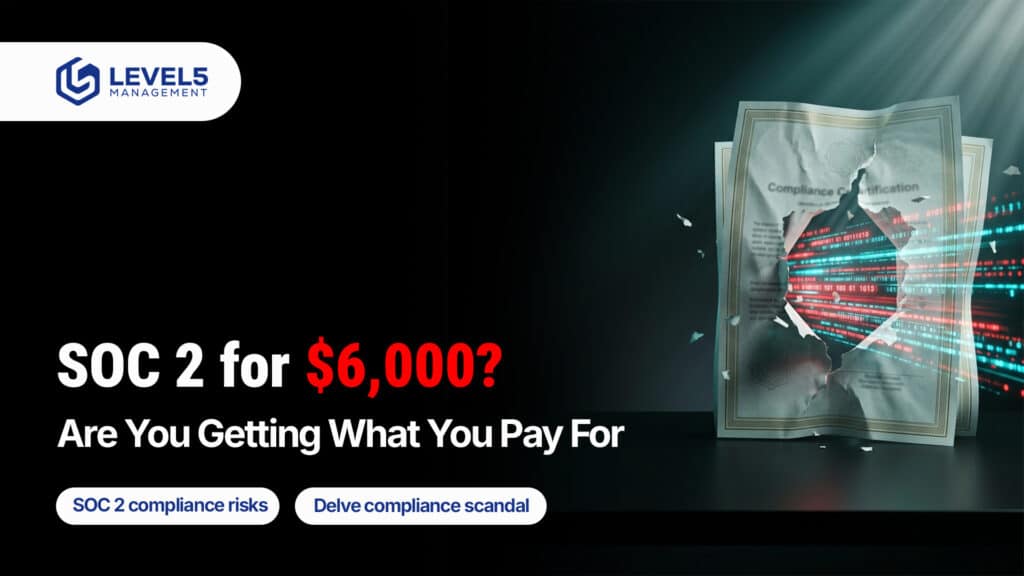
The Delve compliance scandal didn’t just expose one company. It exposed an entire industry cutting corners, and their clients’ businesses are paying the price for it.
You wouldn’t hire a surgeon because they were the cheapest option on Groupon. You wouldn’t trust a fire inspector who never actually visited your building. And yet, somehow, an entire wave of businesses decided that a $6,000 SOC 2 report, a fraction of what legitimate compliance work costs, was totally fine.
What could go wrong?
Well… gestures broadly at the Delve scandal.
Let’s talk about what happened, what it means for your business, and how to make sure you’re not the next company explaining a data breach to your customers because your compliance was about as real as a three-dollar bill.
The Compliance Shortcut That Blew Up at $300 Million
In July 2025, Delve Technologies, a Y Combinator-backed compliance automation startup founded by two 21-year-old MIT dropouts, raised $32 million at a $300 million valuation, led by Insight Partners. Their pitch was irresistible: get SOC 2, ISO 27001, HIPAA, and GDPR certifications fast and cheap through AI-powered automation.
Billboards went up across San Francisco, New York, and Austin. “Compliance is done in Delve” was the tagline. Over 1,700 companies reportedly signed up.
Then, in March 2026, an anonymous whistleblower using the pseudonym “DeepDelver” published an investigation on Substack that alleged what many industry veterans had quietly suspected: the compliance emperor had no clothes.
What the Investigation Alleged
According to publicly reported findings from the DeepDelver investigation, which has since been covered by Inc., Business Insider, and numerous cybersecurity outlets:
- 493 out of 494 leaked SOC 2 reports were reportedly 99.8% identical word-for-word boilerplate, identical grammatical errors, and generic descriptions of cloud architectures that allegedly didn’t match the actual systems of the companies being audited.
- Every single SOC 2 Type II report in the sample reportedly showed “zero security incidents” and “zero exceptions” during the observation period, across hundreds of completely different companies. If you’ve spent even a day in cybersecurity, you know that’s about as likely as every restaurant in a city passing a health inspection with a perfect score on the same day.
- Audit conclusions were allegedly generated before clients even submitted their company descriptions or evidence, which, if true, raises the question: what exactly was being audited?
- Pre-fabricated evidence. including board meeting minutes, policies, and risk assessments, was allegedly provided to clients as templates that functioned more like finished products than starting points.
Note: These are allegations from an anonymous source that have been widely reported on but are not yet adjudicated in court. We present them as reported, not as established fact.
Delve’s Response: Read the Words, Then Watch the Actions
This is where it gets interesting and where, candidly, the satire writes itself.
Delve published three response blog posts in just two weeks (March 20, March 24, and April 3, 2026). That’s not the cadence of a company brushing off a minor misunderstanding. That’s crisis management at full throttle.
Let’s look at what they said versus what they did:
“We do not issue fake SOC 2 reports.”
Delve stated they’re “an automation platform” and that “final reports and opinions are issued solely by independent, licensed auditors, not Delve.”
But then they offered free re-audits to all active customers.
Companies don’t offer complimentary do-overs when the original work was solid. You don’t get a free second opinion from a doctor who’s confident in the first diagnosis.
“Customers work with independent, accredited auditors.”
Delve pushed back against claims about problematic audit firms, stating their auditors are “established firms used broadly across the industry.”
But in the same breath, they announced they were “rebuilding our auditor network and removing firms that don’t meet our standards.”
If the auditor network was already full of established, accredited firms, which ones needed removing, and why?
“We do not produce fake evidence”
Delve described their templates as “starting points only” for customers to customize.
But they simultaneously committed to “making it unambiguously clear in the platform that templates are designed to be starting points only.”
If it was already clear, why the urgent need to make it unambiguously clear now?
“This is a coordinated smear campaign.”
In their April 3 post, Delve’s CEO and COO characterized the whole thing as “a coordinated, targeted cyberattack” by someone who “purchased Delve under false pretenses” and “maliciously exfiltrated data.”
Meanwhile, Y Combinator reportedly removed Delve from its portfolio directory around the same day (approximately April 3, 2026, according to multiple outlets, including Captain Compliance and the Economic Times).
Y Combinator the most prestigious startup accelerator in the world, doesn’t remove portfolio companies over a simple misunderstanding. According to reports, leaked internal communications from YC CEO emphasized that their community is “built on trust,” and that trust had broken down.
And then there was RSA Conference 2026 (March 23–26 in San Francisco). According to industry accounts, Delve had advertised booth presence and invested in sponsorships, but their booth was reportedly empty. For a company running a massive billboard campaign just months earlier telling San Francisco that “compliance is done in Delve,” the silence was deafening.
The Pattern That Speaks Louder Than Words
Here’s the thing you learn in cybersecurity: when someone’s response to an accusation involves simultaneously denying the problem while fixing the problem, the denial doesn’t hold much water.
Delve also announced they were “halting any automation that interacts with audit workflows.” Think about that for a moment. Their entire value proposition was automating compliance workflows. Pausing your core product feature while claiming it was working perfectly is like a restaurant saying “our food is absolutely safe” while replacing every piece of kitchen equipment.
The Chain Breaks: How Fake Compliance Creates Real Victims
If this were just about one startup getting caught cutting corners, it would be a cautionary tale. But the Delve scandal didn’t stay contained; it allegedly contributed to a breach that affected tens of thousands of real people.
Here’s the chain of events, as reported:
- LiteLLM, an open-source AI gateway, reportedly held SOC 2 and ISO 27001 certifications facilitated by Delve.
- Mercor, a $10 billion AI training startup, relied on LiteLLM in its supply chain and presumably trusted those compliance certifications.
- In late March 2026, a threat actor group compromised LiteLLM, using it as a vector to breach Mercor and exfiltrate approximately 4 terabytes of data, including proprietary source code, internal databases, video interviews, and the personal identifying information (PII) of thousands of contractors.
- Meta indefinitely paused its work with Mercor. At least five class-action lawsuits were filed by affected contractors. One lawsuit reportedly names both LiteLLM and Delve as co-defendants.
This is the part that should keep every business leader up at night. Compliance certifications aren’t just paperwork; they’re trust signals. When Company A shows Company B their SOC 2 report, Company B is making real business decisions based on the assumption that the report means something. If it doesn’t, the entire house of cards falls.
The Mercor breach isn’t just a story about hackers. It’s a story about what happens when compliance becomes a checkbox exercise, and the organizations downstream pay the price.
The Industry Finally Responds
The Delve controversy didn’t happen in a vacuum. The entire GRC (Governance, Risk, and Compliance) industry has been watching the race to the bottom in compliance pricing for years. The scandal just made it impossible to ignore.
The AICPA Weighs In
On April 6, 2026, days after Y Combinator’s reported exit and amid the ongoing fallout, the AICPA’s Professional Ethics Division published an article in the Journal of Accountancy titled “SOC engagements: Ethics risks with tool providers.”
The timing wasn’t coincidental.
The guidance specifically warns auditors about the independence and objectivity threats created when CPA firms have business arrangements with compliance tool providers. Key concerns include:
- Undue influence, pressure to subordinate professional judgment to the tool provider’s interests
- Self-interest financial dependencies that compromise objectivity
- Compromised access to evidence in situations where the tool provider controls what the auditor can and cannot see
The article’s conclusion is unequivocal: if safeguards can’t eliminate these threats, “performing or continuing the engagement is not appropriate.”
Translation: the profession’s own governing body is telling auditors that some of these tool-provider arrangements are ethically untenable.
A Broader Industry Problem
Let’s be fair: Delve may be the name in the headlines, but they’re not the only company that’s been racing to the bottom. The entire compliance automation market has been trending toward faster, cheaper, and more templated, and any time an industry optimizes for speed over substance, quality suffers.
A legitimate SOC 2 Type II audit involves:
- Detailed understanding of your specific environment and controls
- An observation period of typically 6–12 months
- Independent testing and validation of controls
- An auditor who will actually flag exceptions when they find them
- A report that reflects your reality, not a boilerplate template with your company name swapped in
That kind of work costs what it costs. When someone offers it for a fraction of the price and a fraction of the time, the question isn’t “how are they doing it so efficiently?” The question is “what are they skipping?”
Are You Getting What You Pay For? The Compliance Reality Check
Whether you’re already SOC 2 certified, working toward it, or evaluating vendors, here are the questions you should be asking right now:
🔍 7 Questions Every Business Should Ask About Their Compliance
- Have you actually read your SOC 2 report? Not the summary, the full report. Does the description of your system match your actual environment? Or does it read like it could describe any company?
- Does your report list any exceptions? If the answer is zero, be skeptical. Every organization has gaps. A report with zero exceptions either means you have the most perfect security program on the planet, or nobody looked very hard.
- Do you know who your auditor is? Can you pick up the phone and call them? Have they ever visited your environment (physically or virtually)? Or were they just a name on a document you never interacted with?
- Was your audit actually observed over time? A SOC 2 Type II report covers an observation period. Was your auditor actually monitoring during that period, or was the report generated after a point-in-time check?
- Did you customize your policies, or are they templates? There’s nothing wrong with starting from a template. But if your information security policy is identical to 493 other companies’ policies, it’s not your security program, it’s a fiction.
- Would your report survive scrutiny from a sophisticated buyer? Enterprise prospects with serious risk departments don’t just check the box. They read SOC 2 reports. They ask pointed questions. A report that can’t withstand scrutiny is worse than no report at all because it creates a false sense of security.
- Is your compliance tool also choosing your auditor? When the platform that helped you prepare for the audit is also the one connecting you with the auditor, ask yourself: whose interests are being served? The AICPA just published guidance specifically because this arrangement creates a conflict of interest.
The Real Cost of Cheap Compliance
Here’s the math that too many businesses get wrong:
A legitimate SOC 2 engagement with a qualified auditor, proper preparation, and a cybersecurity professional guiding the process typically runs $20,000–$50,000+, depending on complexity, scope, and whether it’s Type I or Type II.
A rock-bottom automated SOC 2? You might pay $6,000–$10,000 and get your report in weeks instead of months.
The savings look attractive. But consider what you’re really buying:
- A report that might not survive your next enterprise prospect’s vendor review costing you the deal and the relationship
- A compliance posture that exists on paper but not in practice, meaning your actual security gaps remain wide open
- Potential legal liability if a breach occurs and your “compliance” is found to be hollow as at least five lawsuits against Mercor are now testing
- A ticking clock until a sophisticated customer, regulator, or attacker exposes the gap
The cheapest compliance you can buy is almost always the most expensive mistake you can make.
GRC Tools Don’t Build Your Cybersecurity Program
This is the point the industry needs to hear, loudly and clearly:
Compliance automation tools are not a substitute for an actual cybersecurity program.
Tools can help you organize evidence. They can streamline documentation. They can track controls and manage workflows. That’s genuinely useful.
But a tool cannot:
- Design a security architecture tailored to your business
- Make judgment calls about which risks matter most for your specific environment
- Conduct a genuine, independent assessment of whether your controls actually work
- Challenge your assumptions or tell you uncomfortable truths
- Represent you in a vendor security review or respond to a breach
That requires a human being, ideally, a seasoned cybersecurity professional like a virtual CISO (vCISO) who understands your business, builds a program that fits your reality, and ensures your compliance actually reflects your security posture.
A GRC tool is a useful instrument. But giving someone a stethoscope doesn’t make them a cardiologist.
What Businesses Should Do Right Now
If the Delve scandal has you questioning your own compliance posture, good. That’s the right instinct. Here’s what to do next:
- Audit your audit. Pull out your last SOC 2 or ISO 27001 report and read it critically. Does the system description match your actual environment? Are the controls described actually implemented?
- Verify your auditor’s independence. Were they recommended by your GRC tool provider? Do they have a financial relationship with that provider? The AICPA’s new guidance specifically flags this as a risk.
- Assess your actual security posture. Compliance should be the proof of your security program, not the entirety of it. If you don’t have an actual cybersecurity program underneath the compliance paperwork, you’re building on sand.
- Get expert guidance. Whether it’s a SOC 2 readiness assessment, a security program review, or bringing on a vCISO to build and manage your program, the investment in getting it right is a fraction of the cost of getting it wrong.
Don’t Be the Next Headline
The Delve controversy didn’t create the problem of cheap, hollow compliance; it just made the consequences impossible to ignore. Tens of thousands of people’s personal data were reportedly exposed downstream, billions in enterprise value were put at risk, and an entire industry is now re-examining its practices.
If your business is relying on automated compliance tools without genuine human oversight, without an independent auditor who actually tests your controls, and without a cybersecurity program that exists beyond a set of templates, you’re not saving money. You’re borrowing time.
And eventually, the bill comes due.
Level5 Management helps businesses build real cybersecurity programs that protect your data, satisfy your customers, and prove compliance that actually means something. If you’re questioning whether your current compliance posture would survive scrutiny, let’s talk. We’d rather help you fix it now than explain it later.
