

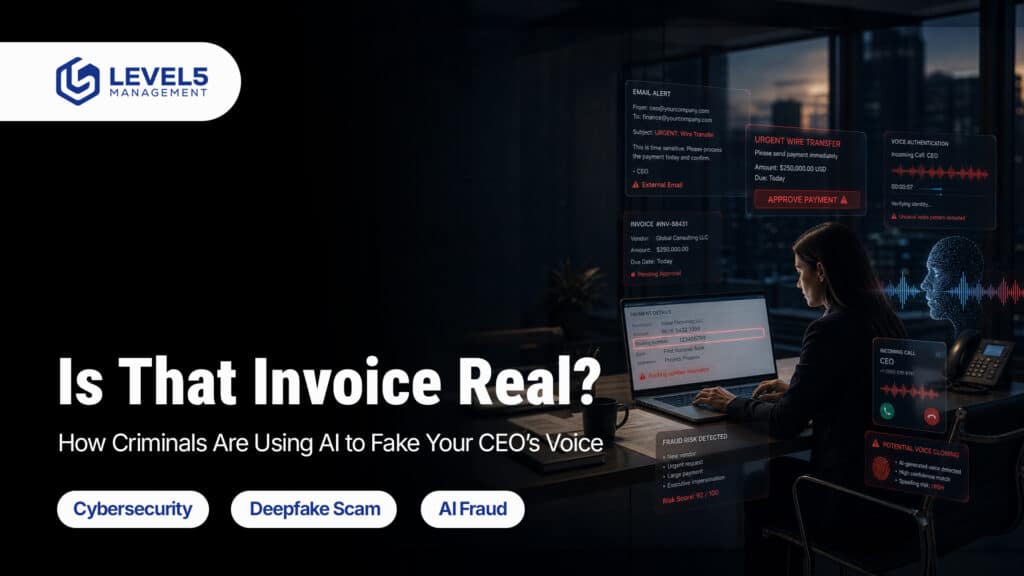
A “quick wire” email from the boss. A voicemail that sounds exactly like him. A vendor is asking you to update their bank account. In 2026, any of those could be a scam, and the AI behind it is so good that even your best employees can’t tell. Here’s how to spot it, stop it, and protect your business, in plain English.
A Quick Story That Happened to a Real Business Last Year
Picture this.
It’s 4:52 on a Friday afternoon. The controller of a 40-person law firm in Boca Raton gets an email from her managing partner. Same signature. Same writing style. Even mentions the closing they had that morning.
“Hey, quick one before the weekend. Need to wire $84,200 to the new escrow account for the Henderson matter. Details attached. Thanks.”
Two minutes later, her phone rings. The caller ID says it’s him. The voice sounds exactly like him. Even the way he clears his throat sounds like him. He says, “Did you get my email? Just push it through, I’m about to get on a flight.”
She pushes it through.
Monday morning, the real managing partner walks in and asks why the firm’s operating account is $84,200 short.
The email wasn’t from him. The voice wasn’t his. Both were fakes made by AI, in under 10 minutes, by someone who had never set foot in Florida.
This is the new face of financial fraud. And if your cybersecurity policy for small businesses doesn’t specifically address it, you’re not protected, no matter how smart your team is.
What’s Actually Happening Here (In Plain English)
The technical name is Business Email Compromise, or BEC. But you don’t need to remember that. Here’s what it really is:
Criminals are using AI to pretend to be someone your team trusts, your CEO, your CFO, or a regular vendor, to trick your business into wiring money to the wrong account.
They don’t hack your servers. and They don’t need to. They just convince one person on your team to approve one payment. And AI has made that convincing part almost free.
The numbers from 2025 are ugly:
- The FBI’s 2025 Internet Crime Report says business email compromise cost U.S. companies over $3 billion last year.
- The FBI also logged $893 million in losses from AI-enabled scams across 22,000+ complaints the first year they tracked it separately.
- Security researchers estimate that around 40% of all phishing emails in 2024 were already written by AI, and that number is climbing fast.
The scary part isn’t the total. It’s the per-incident average. One successful wire can wipe out a year’s profit for a small business.
Why Accounts Payable Is the #1 Target
Think about what the people who pay your bills do every day:
- They process dozens of invoices
- They update vendor bank accounts
- They send wires
- They’re expected to move fast
- They trust emails that look right
That’s not a weakness of people. That’s a weakness of the process. And criminals know it.
Your bookkeeper isn’t going to spot a fake email that:
- Uses the right names
- References the right projects
- Sounds exactly like your CFO
- Comes at the normal time for invoices
- Has perfect grammar
Because in 2026, AI writes emails that are indistinguishable from the real thing. We keep saying the same line to clients across our IT support for CPAs, law firms, and wealth management practices: you cannot train your way out of this. You have to process your way out of it.
The 4 Tricks Criminals Are Using Right Now
Here’s what to watch for. Plain language. Real examples.
Trick #1: The “Fake CEO” Email
The email looks like it’s from your boss. It uses his name in the signature. References something real (often pulled from your LinkedIn, your website, or a previous breach). It asks for an urgent wire, a gift card purchase, or a change to a vendor’s bank account.
Why it works: Your employee wants to help the boss. The boss is “busy” and “about to get on a plane.” Nobody wants to be the person who holds things up.
Trick #2: The “Vendor Changed Their Bank”
You’ve been paying the same supplier for three years. One day, you get an email from “them” saying they switched banks. New account, new routing number, same friendly tone.
Your team updates the file. The next invoice gets paid. To the wrong account.
Why it works: The criminal usually hacked into the vendor’s email first and watched for months. When they send the “we changed banks” email, they reply from inside the real inbox. To you, it looks 100% legitimate.
Trick #3: The Voice Clone
This one is new, and it’s terrifying.
Anyone with 30 seconds of audio of your voice from a podcast, a webinar, a YouTube video, or even a voicemail you left can now clone it. The AI tools that do this used to cost $20,000. Today they’re free.
So, when your controller gets a voicemail that sounds exactly like you, saying, “approve the wire, I’ll explain later”? That might not be you.
Why it works: Until now, a phone call was the gold standard for verifying that something was real. It isn’t anymore.
Trick #4: The “Real” Invoice With a Small Change
The criminal gets into the email thread between you and a real vendor. They watch quietly. When a real invoice gets sent, they intercept it and change two things: the bank account and the remit-to instructions. Everything else, the logo, the PO number, the amounts, the dates, is real.
Why it works: Your AP clerk isn’t looking at the routing number. They’re looking at whether the amount matches what they expected. And it does.
Why Your Old Defenses Don’t Work Anymore
If your current plan against this is:
- ❌ “We train our team to spot weird emails.”
- ❌ “Our email filter catches most of it.”
- ❌ “Our controller always calls to verify.”
- ❌ “We have antivirus and a firewall.”
…then your defense was built for the threats of 2020, not 2026.
Here’s why each one falls short today:
“We train our team.” Training used to work because fake emails had bad grammar, weird logos, and strange sender addresses. AI fixed all of that. There’s nothing left to spot.
“Our email filter catches it.” Filters look for known bad patterns. An AI-written email from a compromised vendor’s real inbox isn’t a known bad pattern. It’s a real email with one wrong number.
“Our controller calls to verify.” A phone call used to be the gold standard. Voice cloning just broke that. If the attacker has 30 seconds of your CEO’s audio, the call confirms the fraud instead of stopping it.
“We have antivirus and a firewall.” Neither one sees what’s happening. No malware was installed. No network was breached. A human read an email and pressed “send wire.”
The honest truth: you can’t defend against this with tools alone, and you can’t defend against it with people alone. You have to defend against it with process.
The 5-Step “Deepfake-Proof” Payment Process
This is the process Level5 helps clients build. It takes about two weeks to roll out, costs almost nothing, and stops every one of the tricks above.
Step 1: One Written Rule: Out-of-Band Verification
“Out-of-band” is a fancy term for a simple idea: if the request came by email, you confirm it by phone. If the request came by phone, you confirm it by email or in person. Never verify a channel using the same channel.
Put this in writing:
Any change to wire instructions, vendor banking, payroll accounts, or any single payment over $[X], must be confirmed by a phone call to a number already on file not the number in the email, not the number on the invoice. No exceptions, including for owners and partners.
One page. Signed by every person who can move money. That’s your single biggest defense.
Step 2: A “Known Numbers” List That Actually Gets Used
Every vendor, every executive, every bank contacts their verified phone number lives in one protected list. New numbers don’t get added without a verification step of their own.
Why this matters: the #1 reason out-of-band verification fails is that the employee calls the number in the fake email. The “known numbers” list removes that mistake.
Step 3: A Two-Person Rule for the Big Ones
For any payment above a threshold your business sets, we usually start clients at $10,000 two people must approve, on two different devices, through two different channels.
It’s the same reason banks require two signatures on a big check. One person can be fooled. Two people, independently, almost never are.
Step 4: A Code Word Nobody Talks About
Pick a simple code word with every executive and every key vendor. It never appears in email and in writing anywhere online. It lives in one place: a written note in your safe or your password manager.
If someone calls and asks for an urgent wire, you ask for the code word. A real CEO will know it. An AI clone won’t.
It sounds silly. It works every single time.
Step 5: A “Slow Down” Culture (Backed by Leadership)
Most wire fraud happens because someone feels embarrassed to question the boss. Your job as the owner is to say, out loud, in front of the team:
“If you ever pause a payment to verify it, even one I asked for, you will be thanked, never punished. Ever.”
Put it in writing. Repeat it at every staff meeting. Mean it.
The companies that get hit aren’t the ones with bad employees. They’re the ones where employees were afraid to ask a second question.
A Quick Self-Check: Is Your Accounts Payable Process Deepfake-Proof?
Answer yes or no. Three or more “no” answers mean your business is exposed right now.
- We have a written rule that no bank account change happens without a phone call to a number already on file.
- Our “known numbers” list exists, is protected, and gets updated on a schedule.
- Payments over our set threshold require two approvers, using two different devices.
- We have a code word with our executives and top vendors that has never appeared in an email.
- Our team knows because leadership has said it out loud that pausing a payment is always the right call.
- Our controller or bookkeeper has been trained on voice cloning and deepfake audio, not just phishing emails.
- We have DMARC set up on our email domain to stop people from impersonating our brand.
- Every finance user logs in with a security key or passkey, not just a password and text code.
- We’ve actually tested this process in the last 12 months with a fake request.
- Our cyber insurance policy specifically covers business email compromise and social engineering fraud.
Three or more “no” answers? Don’t wait. The next Friday at 4:52 p.m. is three days away.
How Level5 Management Protects South Florida Businesses From AI Fraud
Since 2008, Level5 has been the trusted IT, cybersecurity, and compliance partner for law firms, CPAs, wealth advisors, property management companies, and nonprofits across Florida: Boca Raton · Miami · Fort Lauderdale · West Palm Beach · Palm Beach Gardens · Jupiter · Jacksonville · Orlando · Tampa · Sarasota · Naples Colorado: Denver · Colorado Springs · Boulder · Fort Collins · Lafayette Arizona: Phoenix · Scottsdale · Tucson · Mesa · Chandler · Tempe
Our AI fraud prevention engagement includes:
- Free IT Risk Assessment, we walk your AP process, find the gaps, and hand you a prioritized action list in plain English
- vCISO / Virtual CISO services executive-level security leadership without a full-time hire, for a fraction of the cost
- Written payment-process playbooks out-of-band verification, known-numbers lists, two-person rules, and code-word protocols
- 24/7 helpdesk and security monitoring, real humans watching your systems nights, weekends, and holidays, when attackers strike
- Email protection (DMARC, impersonation defense, external-sender banners) is the “bouncer” that stops criminals from spoofing your domain
- Dark web monitoring, we tell you the moment your team’s credentials show up for sale
- Simulated fraud tests, we safely try to trick your team so you know exactly where the gaps are
- HIPAA, SOC 2, FINRA, and FTC Safeguards compliance guidance is built into everything we do
We don’t sell fear. We sell clear process, written proof, and peace of mind so your next Friday afternoon stays boring.
Ready to Deepfake-Proof Your Accounts Payable?
Book a free 30-minute call with Level5 Management. We’ll walk through your current payment process, show you exactly where a criminal with AI could get through, and give you a plain-English action plan whether you hire us or not.
👉 Schedule Your Free IT & Security Assessment 📞 Or call us directly: (561) 509-2077
Because in 2026, the businesses that stay safe aren’t the ones with the smartest employees. They’re the ones with the smartest process.
Frequently Asked Questions
What is a deepfake invoice scam, in plain English?
It’s when criminals use AI to fake an email, a voice message, or even a phone call from someone you trust, your CEO, your CFO, or a regular vendor, to trick your business into wiring money to the wrong bank account. The AI is so good that the fake looks and sounds identical to the real thing.
How common is business email compromise in 2026?
Very. The FBI’s 2025 Internet Crime Report logged over $3 billion in U.S. business email compromise losses last year, plus an additional $893 million in losses specifically tagged as AI-enabled scams. Small and mid-sized businesses are the #1 target because they move real money without enterprise-level controls.
How can a small business prevent a data breach or wire fraud from a deepfake?
The single most effective step is out-of-band verification: any change to bank details or any large payment must be confirmed by phone, using a number already on file, never a number from the email or invoice itself. Pair that with a “known numbers” list, a two-person approval rule, and a code word with your executives, and you stop the vast majority of attacks.
What should a company do if it has already fallen for a wire fraud scam?
Act in the first hour. Call your bank immediately and request a wire recall. File a complaint at ic3.gov within 24 hours the FBI’s Recovery Asset Team has a real shot at freezing funds within 72 hours. Call your cyber insurance carrier before anyone else. Then call your IT and legal partners. Speed is everything.
Does cyber insurance cover deepfake and AI-enabled fraud?
Sometimes. Many basic policies specifically exclude “social engineering” and “voluntary wire transfer” losses. Ask your carrier, in writing, whether your policy covers business email compromise and deepfake-enabled fraud and what controls (like out-of-band verification and MFA) they require to keep that coverage.
Is voice cloning actually a real threat to small businesses?
Yes. The tools to clone a voice used to cost $20,000 and take a week. In 2026, they’re free and take about 30 seconds of audio, which criminals can pull from any podcast, webinar, voicemail, or YouTube video featuring your executives. If your approval process relies on “I recognized their voice,” it’s already broken.
What’s the difference between regular IT support and a vCISO?
Regular IT support keeps your technology running. A vCISO (Virtual Chief Information Security Officer) is a senior security leader who builds your fraud-prevention process, handles compliance, trains your finance team, and talks to your insurance company and auditors on your behalf. You get executive-level expertise for a fraction of a full-time hire.
Why should I choose a local Boca Raton or West Palm Beach IT partner for this?
Because when something goes wrong at 2 a.m., you want a team that can be at your office by breakfast not a call center three time zones away. Level5 has supported South Florida businesses since 2008, and we know the regulators, the insurance carriers, and the industries in this region inside and out.
Article written by the Level5 Management team. Level5 Management is a Boca Raton–based managed IT, cybersecurity, and compliance partner serving small and mid-sized businesses across South Florida since 2008.
