

For years, most small and mid-sized business owners found comfort in a simple assumption: “We are too small for skilled hackers to care about us.”
The logic seemed sound. A sophisticated cybercriminal group had to spend days or weeks manually probing firewalls, writing tailored exploits, and digging through network configs. Why waste expensive human labor on a one-person accounting firm or a regional manufacturing plant when they could chase a Fortune 500 company?
On November 13, 2026, the Federal Bureau of Investigation (FBI) issued an urgent flash advisory that effectively ended that era.
The bureau warned that threat actors are now actively weaponizing autonomous, AI-driven hacking platforms. Leading the alert was an open-source framework named ARTEX, which pairs large language models with automated attack scripts. The FBI’s central finding is blunt: these AI tools enable attackers with minimal technical skill to move from initial target scanning to full, privileged network compromise in under three hours with almost no human intervention.
When hacking costs zero human effort, no business is too small to be attacked.
How Autonomous AI Collapses the Attack Timeline
Traditional cyber intrusions unfold over days, weeks, or months. An attacker manually runs port scans, studies the results, tests individual software exploits, attempts credential stuffing, and moves laterally from computer to computer.
Autonomous AI changes the economics of cybercrime by handing the entire operational process over to software agents.
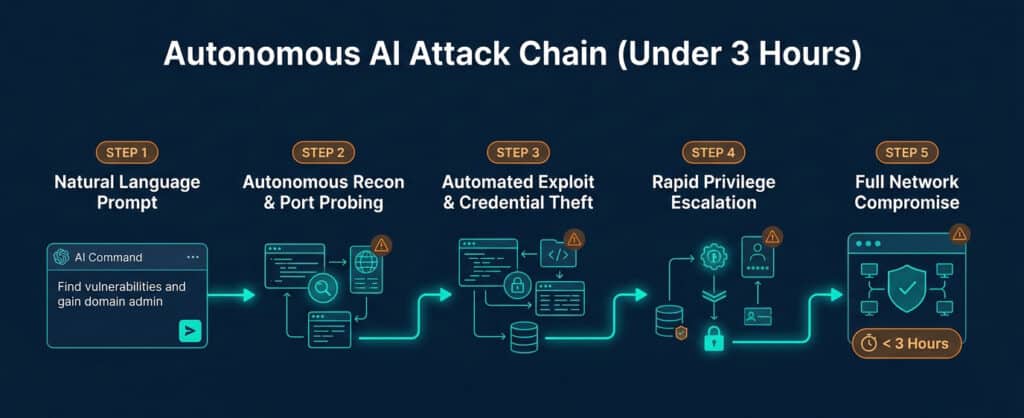
In an autonomous framework like ARTEX:
- A single operator types a high-level goal: The attacker does not need advanced programming or exploit-writing skills. They provide a target domain or IP range and a simple prompt, such as ‘Scan this network, identify exploitable weaknesses, and escalate to domain administrator.’
- AI agents run the recon: The platform deploys specialized software agents that automatically map public-facing assets, test remote login portals, detect outdated software versions, and query search engines for leaked company credentials.
- Decisions happen at machine speed: When the AI encounters an obstacle such as a firewall block or a patched service, it does not stop. It analyzes the error message, adjusts its commands, and tries alternative attack vectors immediately.
- Autonomous privilege escalation: Once the software secures a foothold on a single endpoint, it searches for stored credentials in browser caches, queries internal directory services, and exploits local configuration flaws until it gains administrator control.
What used to require a team of five seasoned penetration testers working for two weeks now happens autonomously while an attacker sleeps.
What the FBI Disclosed: Real-World Campaigns Underway
The FBI’s alert was not theoretical. It detailed live campaigns where attackers weaponized the tool across critical infrastructure and commercial sectors:
- South Korean Banking Intrusions: Cybercriminals used ARTEX against financial institutions in South Korea, rapidly bypassing perimeter defenses to exfiltrate personal records belonging to roughly 67,000 individuals.
- ConnectWise Cloud Backup Exploitation: Attackers directed automated AI tools against ConnectWise cloud backup infrastructure, launching automated sign-in attempts against more than 2,250 downstream client environments in a single operation.
- Broad Sector Targeting: The advisory identified active attacks targeting healthcare providers, manufacturing plants, defense contractors, energy utilities, law firms, and tech companies.
After security researchers publicly documented the abuse, the original developer deleted the public ARTEX GitHub repository in October 2026. But open-source code rarely disappears. Threat actors quickly created mirrors, distributed localized versions, and began selling an upgraded commercial variant called ‘ARTEX PRO’ on dark-web forums.
Today, cybersecurity researchers track more than 1,600 publicly accessible ARTEX instances running across the internet.
Why Traditional Small Business “IT” Defenses Fail
Most small businesses rely on an “IT” model designed for a different decade.
Typically, an outside provider runs basic antivirus software on workstations, applies Microsoft updates once a month on ‘Patch Tuesday,’ and reviews server logs if something breaks.
Against human attackers, this passive model occasionally gave defenders enough time to notice warning signs. Against autonomous AI, it fails completely:
- The 3-hour window beats the 30-day patch cycle: If an AI tool discovers an unpatched vulnerability on Friday night, it can compromise the entire network by midnight. An “IT” team that applies patches every two to four weeks will arrive days too late.
- Standard antivirus cannot recognize native commands: ARTEX and similar frameworks rely heavily on ‘living-off-the-land’ techniques. Instead of downloading obvious malware files that trigger signature-based antivirus alerts, the AI executes legitimate administrative tools like PowerShell, Windows Management Instrumentation (WMI), and remote desktop protocols. To standard antivirus software, the attack looks like normal system administration.
- Mass automation eliminates obscurity: Small businesses previously stayed safe through obscurity; there were simply too many businesses for hackers to manually investigate every single one! Autonomous AI scripts can scan millions of IP addresses per day for pennies in cloud computing costs. Every business connected to the internet is now scanned continuously.
Five Practical Steps Every Business Must Take Today
Defending against machine-speed attacks does not require an enterprise-sized budget, but it does require moving away from passive “IT” maintenance. Here are five direct steps business leaders should review with their “IT” teams immediately:
1. Deploy 24/7 Managed Detection and Response (MDR)
Traditional antivirus alerts you after a computer is already infected. Managed Detection and Response (MDR) pairs endpoint behavioral sensors with a 24/7 Security Operations Center (SOC). When software on a laptop begins running unusual administrative commands or probing internal subnets at 2:00 AM, behavioral systems automatically isolate the machine from the network in seconds, cutting off the AI tool before it spreads.
2. Take Remote Management and Admin Portals Off the Public Web
Never allow remote desktop (RDP) connections, firewall management consoles, or remote monitoring tools to face the open internet directly. Place all administrative interfaces behind a private VPN or Zero Trust Network Access (ZTNA) solution with strict IP allowlisting. If an AI scanner cannot find an open login page, it cannot target it.
3. Move to Phishing-Resistant MFA (Passkeys and Windows Hello)
Standard multi-factor authentication that relies on SMS text codes or simple mobile push prompts can be bypassed by automated session-theft tools. Upgrade your team to phishing-resistant authentication, such as FIDO2 hardware security keys, Windows Hello biometrics, or device-bound passkeys.
4. Enforce Enterprise Password Management and Disable Default Accounts
Automated tools routinely test factory-default credentials on firewalls, network switches, office cameras, and NAS storage drives. Enforce a federally approved enterprise password manager across your entire staff, eliminate shared passwords, and audit your network to ensure no default administrator accounts remain active.
5. Audit Third-Party Vendor and Supply-Chain Tools
The FBI advisory specifically highlighted attacks targeting backup platforms and MSP tooling. Ask your managed “IT” provider how they secure their own infrastructure, whether their management consoles sit behind private networks, and how quickly they apply emergency security patches to their monitoring agents.
The Bottom Line
The FBI’s alert makes one reality unmistakable: the cost of launching a sophisticated cyberattack has plummeted, while the speed has multiplied.
When autonomous software can identify a vulnerability and compromise a business network in three hours, relying on periodic “IT” checkups is no longer a defense strategy. Business owners must demand modern, 24/7 behavioral protection and disciplined security hygiene from the teams managing their networks.
Frequently Asked Questions
Q: What makes an autonomous AI hacking tool different from regular vulnerability scanners?
A: Traditional vulnerability scanners simply check for known software flaws and produce a static report for a human to review. Autonomous AI tools take action. They interpret the scan results, write custom scripts, attempt logins, exploit discovered flaws, and escalate access through the network without requiring a human operator to guide each step.
Q: Can autonomous AI tools breach our network if our staff never clicks a phishing link?
A: Yes. While phishing remains a common entry point, autonomous tools frequently enter through internet-facing equipment, such as unpatched firewalls, exposed remote desktop ports, misconfigured cloud storage buckets, or outdated VPN appliances. They do not need human interaction to gain a foothold.
Q: Does our standard antivirus software protect against tools like ARTEX?
A: Generally, no. Standard antivirus relies on recognizing known malicious file signatures. Autonomous AI frameworks often use legitimate operating system tools (such as PowerShell and command-line utilities) and generate fresh, dynamically adapted commands. Detecting these intrusions requires behavioral monitoring (EDR/MDR) that spots suspicious activity rather than just known bad files.
Q: How does a small business defend against attacks that move in under three hours?
A: The defense must also be automated. Modern Endpoint Detection and Response (EDR) platforms detect abnormal behavior such as an endpoint running automated credential harvesting commands and automatically isolate the device from the local network within seconds. This halts the intrusion instantly, long before an attacker can reach your central servers.
Q: What questions should we ask our “IT” provider about this FBI warning?
A: Ask your provider: (1) Do we have 24/7 behavioral endpoint monitoring (MDR/EDR) actively watching our systems? (2) Are any of our administrative or remote access portals exposed directly to the public web? (3) How quickly are emergency security
Find Out What Autonomous Scanners Can See on Your Network Before Attackers Do
An autonomous AI tool only needs one open remote desktop port, an unpatched firewall, or a single leaked password to gain a foothold. In a 30-minute consultation, our security team will run an external exposure scan on your public-facing network, check your perimeter controls, and give you a straightforward assessment of where your risks lie.
Schedule Your Free Security Consultation