

If your company operates a website, an e-commerce storefront, a client portal, or custom web applications, there is an overwhelming chance your infrastructure relies on PHP. Nearly 75% of the entire web runs on it including major platforms like WordPress, Drupal, Joomla, Magento, and Laravel. On October 21, 2026, Reuters reported an unprecedented emergency: European […]
Author Archives: Level5 Management
AI, Cybersecurity
BREEZE COMET: The AI-Assisted Crew That Broke Into Brazil’s Banks, And Why U.S. Businesses Should Pay Attention
30
Sep
Sep
A financially motivated hacking group tracked as BREEZE COMET has been sitting inside Brazilian banks since 2024. Google’s Threat Intelligence Group and Mandiant just laid out how they did it, and one detail stands out from the rest: parts of their toolkit were written with generative AI. This isn’t a story about a faraway bank […]




Cybersecurity
Is That Invoice Real? How to Avoid a Data Breach When Criminals Are Using AI to Fake Your CEO’s Voice
13
Jul
Jul
A “quick wire” email from the boss. A voicemail that sounds exactly like him. A vendor is asking you to update their bank account. In 2026, any of those could be a scam, and the AI behind it is so good that even your best employees can’t tell. Here’s how to spot it, stop it, […]
Cybersecurity
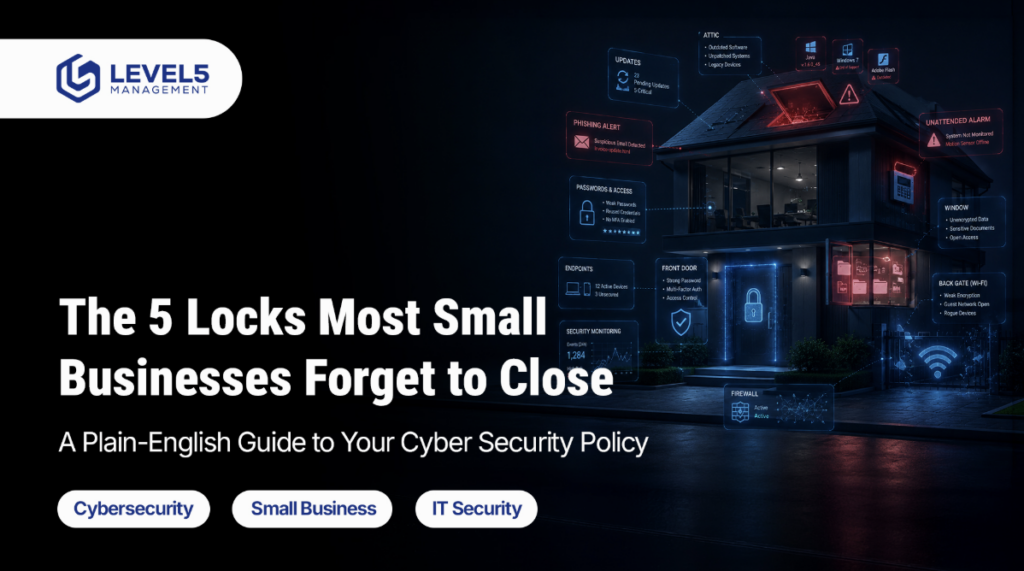
The 5 Locks Most Small Businesses Forget to Close (A Plain-English Guide to Your Cyber Security Policy)
17
Jun
Jun
If your front door had five locks, would you really leave three of them open? That’s what most small businesses are doing online right now, and they don’t even know it. Here’s how to spot the open locks and close them, written so anyone can follow along. Let’s Start With a Simple Picture Imagine your […]
04
Jun
Jun
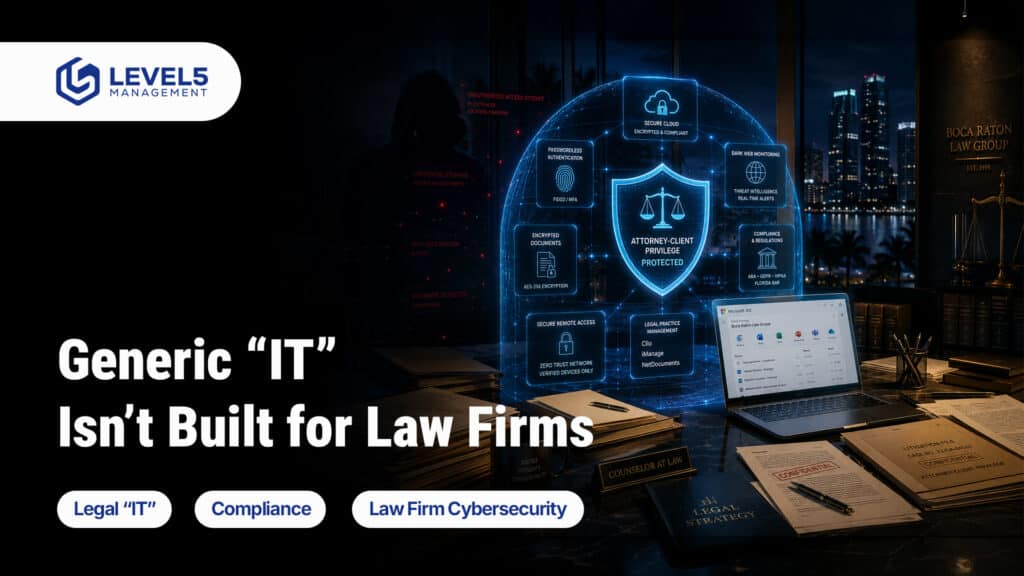
A general “IT” company can keep a printer online. That’s not what your practice needs. Here’s what real IT services for law firms look like in plain English from Boca Raton, across South Florida, and beyond. Your Practice Isn’t a Regular Business. Your “IT” Shouldn’t Be Regular Either. A law firm isn’t like the dental […]
Cybersecurity
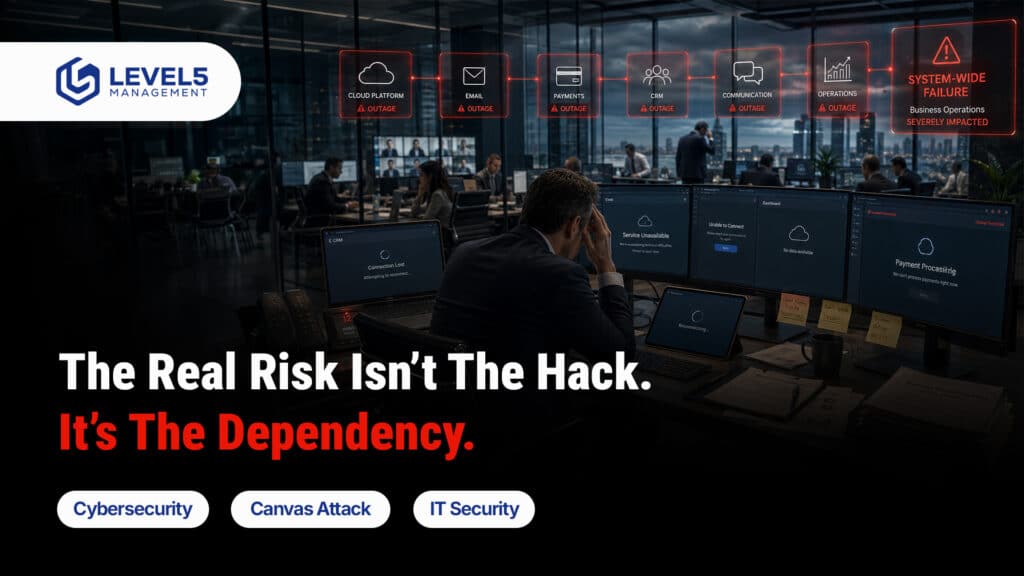
The Canvas Hack Didn’t Just Strand College Students. It’s a Warning for Every Business in America.
21
May
May
Hackers hit one of the most relied-on platforms in American education right in the middle of finals week. The real lesson isn’t about students. It’s about what happens when one vendor your business depends on gets breached. Here’s what actually happened, in plain English, and 7 steps every owner should take this week. What Happened […]

16
Apr
Apr
The Delve compliance scandal didn’t just expose one company. It exposed an entire industry cutting corners, and their clients’ businesses are paying the price for it. You wouldn’t hire a surgeon because they were the cheapest option on Groupon. You wouldn’t trust a fire inspector who never actually visited your building. And yet, somehow, an […]
10
Apr
Apr
AI is moving fast. But so are attackers. Two recent developments highlight a growing and uncomfortable reality: AI is not just transforming businessIt is also transforming cyber threats From malware disguised as leaked AI code to AI systems being abused for unauthorized crypto mining, the risk is no longer theoretical. It is already happening. Incident […]
20
Mar
Mar
A newly disclosed high-severity vulnerability in ConnectWise ScreenConnect (CVE-2026-3564) is raising concerns across the cybersecurity community. With a CVSS score of 9.0, this is not a minor issue. It highlights a deeper reality many organizations are starting to recognize: Remote access tools, while essential, are increasingly becoming high-value targets for attackers. What Is CVE-2026-3564 (In […]
18
Mar
Mar
Recent reports of a cyberattack on a major medical technology company, allegedly linked to a nation-state–affiliated group, are raising serious concerns across industries. This wasn’t just another ransomware incident. It may have been something far more destructive: a wiper attack. Unlike ransomware, which is designed to extort, wiper attacks are built to destroy wiping systems, […]
How Title Companies Must Upgrade Their IT Systems for the 2026 FinCEN Reporting Rule The FinCEN Real Estate Reporting Rule, taking effect on March 1, 2026, is being discussed mostly as a compliance issue. But let’s be honest. For title companies, this isn’t just about filling out another form. It’s about infrastructure.It’s about data security.It’s […]

18
Jul
Jul
The CFO’s role has evolved. No longer focused solely on balance sheets and cash flow, today’s CFO is at the center of enterprise-wide decision-making, including cybersecurity. According to Gartner, over 70% of CFOs now oversee areas beyond finance, such as digital transformation, compliance, and cybersecurity for CFO functions. For finance leaders, that shift presents a […]

14
Jul
Jul
In a quiet office in Tampa last February, a small construction firm unknowingly clicked a hyper-realistic invoice link from a known vendor. In under two hours, their network was encrypted. The attackers demanded $350,000 in cryptocurrency. The common factor is that they’re all AI-generated. The sender? Deepfake spoofed.

10
Jul
Jul
Hiring an in-house IT team seems logical for many growing businesses. You want someone on-site, someone who “knows the ropes.” You desire an on-site individual with extensive knowledge and experience. However, as your company scales and technology becomes more critical to your operations, an internal IT model’s financial performance often begins to show quickly.

06
Jul
Jul
Walk through any modern manufacturing floor today, and you’ll see more than just machines humming and conveyor belts moving. You’ll find intelligent systems collecting real-time data, connected devices communicating across networks, and operations tuned to the second. Manufacturing technology is evolving in this era, transforming the production, maintenance, and transportation of products.

01
Jul
Jul
Small and mid-sized businesses often grapple with the challenge of providing reliable services within their limited IT budgets, all while keeping pace with rapidly evolving technology. Buying new hardware every few years, managing upgrades, and handling breakdowns—it’s resource-heavy, capital-intensive, and often unpredictable.

30
Jun
Jun
As more businesses accelerate their digital operations, many are faced with a pivotal infrastructure decision: Should they invest in a hybrid cloud model or adopt a multi-cloud strategy? While both approaches offer significant flexibility and performance benefits, understanding their differences and the context in which one may outperform the other is critical to making the right call.
30
May
May
IT operations and cybersecurity have always been high-stakes domains, but artificial intelligence (AI) is rapidly raising the bar. AI has reshaped how businesses detect threats, respond to incidents, and streamline technical support. As companies race to keep pace with rising attack vectors and operational demands, AI in IT support and cybersecurity is shifting from a futuristic concept to a present-day necessity.
19
May
May
When people think about cybersecurity breaches, their minds often jump to banks, healthcare providers, or massive corporations. Rarely do they picture law firms. However, for cybercriminals, legal practices are high-value targets. That’s because law firms hold a goldmine of sensitive data: client records, contracts, confidential communications, financial documents, etc.
15
May
May
Microsoft has quietly introduced a new OneDrive feature that could pose a serious threat to your company’s data security — and unless you’ve taken action, your organization might already be exposed. At Level5 Management, we made it our priority to address this risk before it could impact our clients. What’s Changing with OneDrive? The new feature, […]
- 1
- 2